


Every analogue phone line in the UK will stop working by 31 January 2027, when Openreach retires the old copper PSTN network for good. If you haven’t heard from your provider yet, don’t wait: call them now, confirm your migration date, and flag any telecare or alarm equipment that plugs into your phone line before it gets switched over automatically.
TL;DR:
- By January 31, 2027, all analogue landlines in the UK will be discontinued, with providers migrating customers in phases depending on their locations.
- Critical devices such as telecare alarms, payment terminals, lift emergency phones, and monitored alarm systems may stop working unless they are tested and adapted before migration.
- Households should confirm whether their new digital voice service runs over fibre or reused copper to ensure compatibility with existing equipment and power backup options.
- Businesses must conduct an early audit of all PSTN-dependent devices, engage their providers proactively, and consider managed migration support to avoid disconnection risks.
- Vulnerable customers should declare their telecare devices beforehand, request compatibility testing, and verify backup power arrangements to maintain connectivity after the switch-off.
Table of Contents
- What is the PSTN switch off and why is it happening?
- Who is affected and when will PSTN be stopped in the UK?
- What are the digital options replacing the landline?
- Which devices might stop working after PSTN switch off?
- How do I prepare as a household before the switch off?
- How should businesses prepare for the digital voice transition?
- What protections exist for vulnerable and telecare customers?
- What if I haven’t been contacted or my migration has problems?
- Why businesses shouldn’t leave PSTN migration to the last minute
- How CTA Systems handles your migration to digital voice
- Where to check the official rules and get further help
- Sources
- FAQ
What is the PSTN switch off and why is it happening?
PSTN stands for Public Switched Telephone Network, the copper wiring system that has carried UK phone calls since the Victorian era. ISDN, its business‑grade cousin, rides on the same ageing infrastructure. Both are being retired in favour of All‑IP, where voice calls travel as data over a broadband connection rather than an analogue signal down a copper wire.
The reasoning is mostly practical. Copper degrades, exchanges built decades ago are expensive to maintain, and spare parts for some of the older equipment are increasingly hard to source. Digital voice calls are also more resilient to certain faults and easier to route around network problems.
This is an industry‑led transition, not a government mandate, though Gov sets out the framework providers must follow. The practical upshot for you:
- Landlines will run over your broadband router, not a separate copper pair
- Existing handsets usually still work, just plugged into a different socket
- Providers are responsible for testing and migrating customers in phases
- The change applies to every UK provider, not just BT and Openreach
Who is affected and when will PSTN be stopped in the UK?
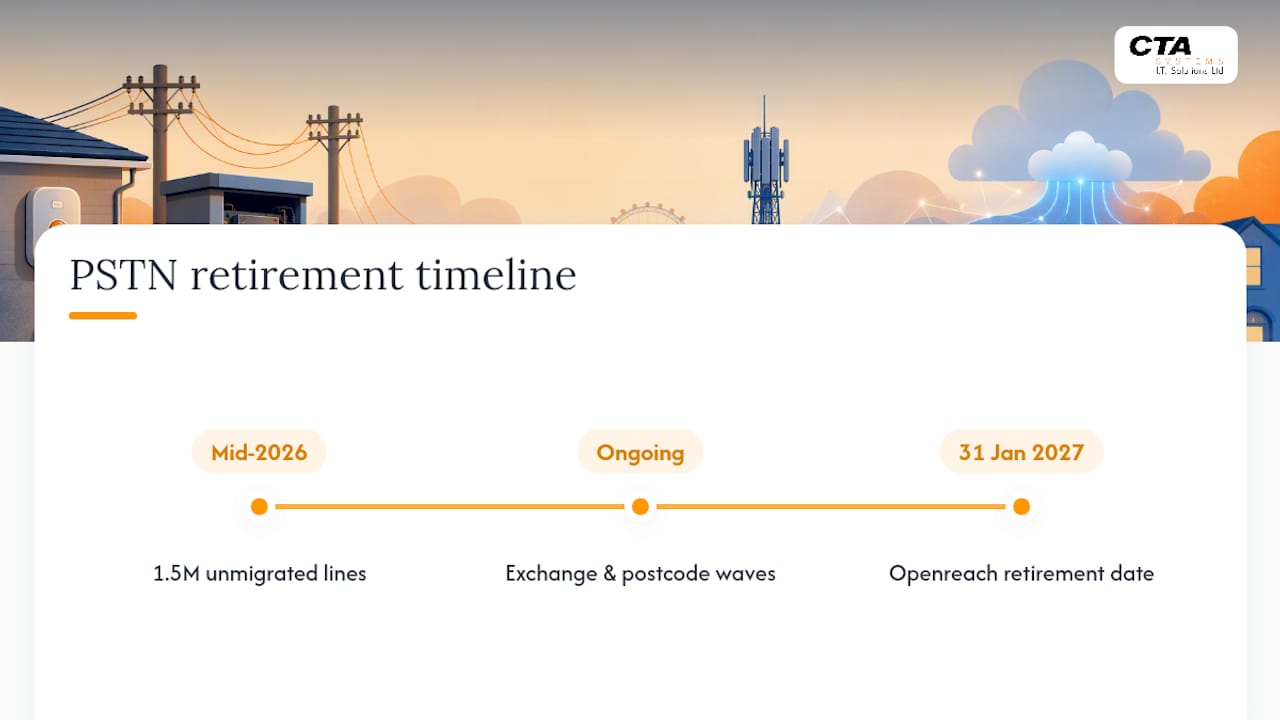
Everyone with a landline is affected, but not everyone faces the same deadline pressure. Openreach’s national retirement date is 31 January 2027, and providers are migrating customers in waves running up to that point, exchange by exchange, postcode by postcode.
Consumers get more breathing room. If something goes wrong, Ofcom rules require providers to offer temporary Emergency Voice Access and, where needed, a landline‑only digital service for people who don’t want a full broadband package.
Businesses face a harsher reality. A line that hasn’t migrated by the deadline risks hard disconnection, with no equivalent fallback guaranteed. That risk isn’t hypothetical.
1.5 million analogue lines across the UK were still unmigrated as of mid‑2026, according to Openreach data reported by ISPreview. Business customers make up a disproportionate share of that backlog, often because migration gets deprioritised against day‑to‑day operations.
What are the digital options replacing the landline?
The replacement isn’t one product, it’s a family of services, and which one lands on your doorstep depends on your provider, your broadband, and your usage.
VoIP (Voice over Internet Protocol) and Digital Voice both mean the same practical thing: your calls travel over the internet rather than a dedicated copper line. You keep a phone number, you can usually keep your existing handset, but the signal now runs through your router.
For households without general broadband, providers are required to offer a landline‑only digital service, a scaled‑down connection built purely to carry voice calls without a full internet package, as confirmed in gov.uk transition guidance.
Some providers deliver digital voice over existing copper using technologies like SOGEA or SOTAP rather than full fibre. That matters because:
- Full fibre setups typically need an ONT (optical network terminal) plus a compatible router
- SOGEA/SOTAP reuses your existing copper pair, so installation is often simpler
- Neither option restores the old analogue signal once switched, so any device plugged into the phone socket needs checking
Pro Tip: Ask your provider explicitly whether your new service will run over fibre or reused copper. It changes what equipment you need and how a power cut will affect your phone line.
Which devices might stop working after PSTN switch off?
Anything hardwired to expect an analogue dial tone is at risk, and some of these are safety‑critical.
- Telecare and personal alarms. Pendant alarms, fall detectors, and monitored panic buttons often rely on the specific electrical characteristics of an analogue line. Citizens Advice guidance is unambiguous: tell your provider you use one before migration happens, not after.
- Payment terminals in shops and cafés that dial out over a phone line for card authorisation.
- Lift emergency phones, common in blocks of flats and commercial buildings, which need continuous power and a working line to summon help.
- Monitored alarm systems for burglar and fire alarms that call a monitoring centre.
- Fax machines and older bespoke equipment, including some medical devices, that were never designed with digital voice in mind.
Test each device once your line migrates, and expect that some will need an adaptor or a scheduled engineer visit to keep working.
How do I prepare as a household before the switch off?
- Check whether your provider has already been in touch. Most are contacting customers by post, email, or text well before their scheduled migration slot.
- If you or someone in your home uses telecare or a personal alarm, tell your provider directly and ask for a compatibility test, as Citizens Advice recommends. Many providers will arrange a free engineer visit for this.
- Decide whether you need full broadband alongside your new phone line, or whether a landline‑only digital service suits you better.
- Confirm what happens to your phone during a power cut. Digital voice services rely on your router having power, unlike old analogue lines, so ask about battery backup units if you have no mobile signal at home.
Pro Tip: Keep your account number and a note of any special equipment (alarm, lift phone, monitored system) to hand. It speeds up every call you make to your provider about migration.
How should businesses prepare for the digital voice transition?
Start with an honest audit. Walk through every phone line in the building and ask what’s actually connected: card machines, alarm dialers, fax lines, lift phones, out‑of‑hours answering services. Businesses that treat this as a five‑minute admin task are the ones that end up disconnected without warning.
- List every PSTN‑dependent device and test each one against your migration date
- Contact your provider early. Engineering slots fill up, and last‑minute requests get pushed back
- Ask directly about your SLA during and after migration, particularly for anything customer‑facing
- Budget for interim costs: temporary mobile backup, a managed migration service, or overlapping contracts while you test the new setup
- Don’t assume your existing router or switchboard is compatible; confirm it in writing
Businesses with multiple sites or complex phone systems often benefit from a managed migration rather than a DIY approach, simply because the coordination overhead multiplies with every extra line.
What protections exist for vulnerable and telecare customers?
Providers have signed up to a PSTN charter committing to extra care for vulnerable customers during migration, including guaranteed testing before any telecare‑linked line is switched.
- Declare any personal alarm, fall detector, or monitored medical device to your provider before migration
- Ask for a compatibility test and, where the provider agrees it’s needed, a free engineer visit
- Request battery backup information if you have no reliable mobile signal at home
- Contact Citizens Advice or your local authority’s social care team if your provider is slow to respond
What if I haven’t been contacted or my migration has problems?
If your migration date has come and gone with no contact, don’t assume you’re fine. Ring your provider, quote your account number, and ask directly for your scheduled date and whether any telecare or business‑critical equipment has been flagged.
- Gather your account details and a list of any dependent devices before you call
- If the provider is unresponsive, escalate through their formal complaints process, then Ofcom or Citizens Advice if that stalls
- In the short term, a landline‑only digital service or temporary mobile voice can bridge the gap
- For businesses, a managed IT provider can often resolve equipment compatibility faster than waiting in a general support queue
Why businesses shouldn’t leave PSTN migration to the last minute
The pattern repeats across every migration deadline in telecoms: households sort it out because a provider chases them, and businesses drift because nobody owns the problem. I’ve seen the same failure mode again and again, a card machine or alarm dialer nobody remembered was on the old line, discovered only when it stops working.
Managed IT and VoIP support closes that gap by testing telecare and critical equipment before the cutover, not after. Migration planning like this can be handled by managed IT providers, which is worth knowing if your business has more than a handful of lines to move.
— Will
How CTA Systems handles your migration to digital voice
A practical alternative to muddling through a PSTN migration alone is to engage a managed IT provider who can handle the planning, equipment checks, and telecare or alarm testing before your cutover date arrives.

The VoIP and IP telephony service covers the actual phone system migration, while managed IT support adds ongoing remote monitoring so a fault gets caught before it costs you a working day. Businesses on a Care Plan get this handled as part of a fixed monthly arrangement, with no surprise call‑out fees when something needs fixing mid‑migration.
If your business has more than one line, a monitored alarm, or a card machine you can’t afford to lose, consider booking a migration review with a managed IT provider before your provider’s deadline arrives.
Where to check the official rules and get further help
For the official deadline and provider obligations, use gov.uk’s transition guidance. Telecare users should start with Citizens Advice, businesses with BT Business’s switch‑off guide, and anyone wanting policy context can read the House of Commons Library briefing.
Sources
- UK transition from analogue to digital landlines
- Check your personal alarm will work after the landline switch off – Citizens Advice
- Openreach warns 1.5 million UK analogue phone lines yet to make digital switch – ISPreview
- Your guide to the PSTN switch-off – BT Business
FAQ
Can I keep my landline after 2027?
Yes, but it will run as a digital service over broadband or a landline‑only connection rather than the old copper PSTN line. Your phone number usually stays the same; only the underlying technology changes.
Are landlines being stopped in the UK?
The analogue PSTN network itself is being retired by 31 January 2027, but landline calling isn’t disappearing, it’s moving to digital voice over broadband. Providers are required to offer alternatives, including a landline‑only digital option for people without general broadband.
Are BT planning to remove landlines?
BT and Openreach are migrating customers to All‑IP digital voice ahead of the 2027 deadline, not removing landline service altogether. BT Business’s own guidance confirms customers keep a phone line and number, just delivered over a different network.
Why is PSTN being switched off?
The copper network is decades old, increasingly costly to maintain, and technically limited compared with digital alternatives. Retiring it in favour of All‑IP gives providers a more resilient, easier‑to‑manage network, with the industry setting 31 January 2027 as the national cutoff.
What happens to businesses that miss the migration deadline?
Businesses that haven’t migrated by 31 January 2027 risk hard disconnection, unlike consumers who may get temporary emergency voice access. Booking a migration slot with your provider, or working with a managed IT partner like CTA Systems, reduces that risk considerably.


